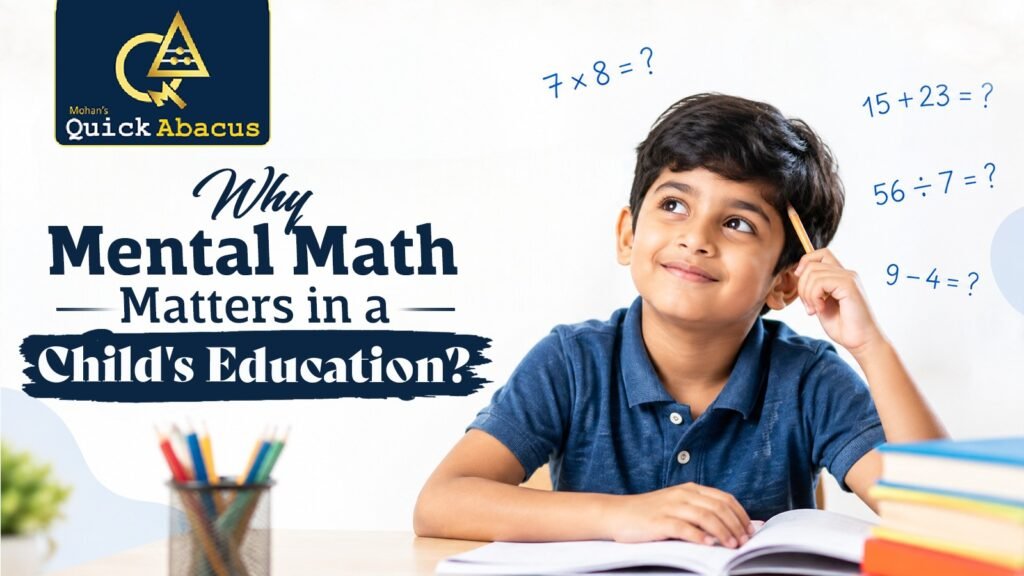
Mental math is more than calculating numbers without paper; it encourages children to think quickly and approach problems with confidence. Regular numerical practice can strengthen concentration, memory, accuracy, and logical thinking. These abilities can support children not only in mathematics but also in everyday decision-making. With enjoyable activities and consistent practice, mental calculation can become a natural part of a child’s learning journey.
What Is Mental Math?
Mental math refers to solving calculations in your head rather than depending entirely on written steps or a calculator. Children gradually learn to recognise numerical relationships, remember values, and apply calculation strategies mentally. Abacus and Vedic Maths training can provide children with structured opportunities to practise these abilities while developing a stronger understanding of numbers.
Why Should Children Develop Mental Math Skills?
Mathematics is present throughout a child’s education, from basic arithmetic in the early grades to more advanced concepts later. Mental calculation can help children process simple numerical problems efficiently and feel more prepared when working through mathematical exercises. With guidance from an experienced abacus trainer, children can learn calculation techniques progressively according to their learning level.
1. Builds Faster Thinking
Mental calculations require children to process information and decide which approach to use. As they practise regularly, they can become more familiar with numerical patterns and calculation methods. This can encourage quicker thinking without making speed the only focus of learning.
2. Strengthens Concentration
When children calculate mentally, they need to remember numbers, follow steps, and keep their attention on the problem. This makes calculation a focused activity that can encourage children to stay attentive for longer periods. Presenting these exercises through fun and engaging learning for kids can make regular practice feel less like additional schoolwork.
3. Improves Accuracy and Confidence
Children may sometimes hesitate when faced with numbers because they are worried about making mistakes. Regular practice can help them become more familiar with calculations and gradually improve their accuracy. Using proven math learning techniques can give children a structured way to practise while allowing them to learn from mistakes and recognise their progress.
Mental Math Skills and Their Benefits
Skill | How It Can Help Children |
Concentration | Helps children stay focused on calculations |
Memory | Encourages them to retain numbers and steps |
Speed | Supports quicker responses to basic calculations |
Accuracy | Develops careful calculation habits |
Confidence | Makes children more comfortable with numbers |
Logical thinking | Encourages children to identify patterns and relationships |
4. Supports Everyday Problem-Solving
Mental math is useful beyond the classroom. Children can use numerical thinking when comparing prices, calculating change, estimating quantities, reading time, or keeping scores during games. Brain development training for kids can complement these experiences by encouraging children to use memory, attention, and reasoning while working through age-appropriate challenges.
5. Encourages Independent Learning
When children become comfortable with mental calculations, they may rely less on external aids for simple numerical problems. They can attempt questions independently, check their reasoning, and identify alternative ways to reach an answer. This sense of independence can make mathematical learning more rewarding and encourage children to take an active role in their education.
Simple Ways to Practise Mental Math at Home
Parents can make mental calculation part of everyday activities without creating pressure. Try introducing short challenges such as:
- Asking children to calculate simple shopping totals.
- Giving quick addition or subtraction questions during travel.
- Using number cards for multiplication challenges.
- Asking children to estimate quantities before counting.
- Creating family-based calculation games.
- Encouraging children to explain how they found an answer.
Regular mental math classes for faster calculation can also provide children with a consistent environment where they can practise calculations, learn new strategies, and gradually increase the level of difficulty.
How Quick Abacus Supports Mental Math Development?
Quick Abacus helps children approach mathematics through structured practice, guided learning, and activities designed to develop numerical confidence. The learning process can support calculation, concentration, memory, visualisation, and mental processing skills in an age-appropriate manner. For parents considering abacus classes for school children, Quick Abacus can complement regular academic learning by giving children additional opportunities to practise mathematical thinking in an engaging environment.
Make Mental Math a Positive Experience
Children do not need to master difficult calculations immediately. The most effective approach is to begin with concepts they understand and gradually introduce new challenges. Short practice sessions, positive encouragement, and activities suited to their ability can help maintain interest. When children are encouraged to focus on progress rather than perfection, they can develop a healthier and more confident attitude towards mathematics.
Conclusion
Mental math can play a valuable role in a child’s education by developing skills that extend beyond calculation. Better concentration, memory, accuracy, logical thinking, and confidence can support children across different areas of learning. With regular practice and the right guidance, mental calculation can become an enjoyable skill that children carry from the classroom into everyday life.
Help your child explore numbers through structured, enjoyable learning with Quick Abacus.
“Learning numbers with confidence can help children develop stronger thinking and problem-solving skills.”