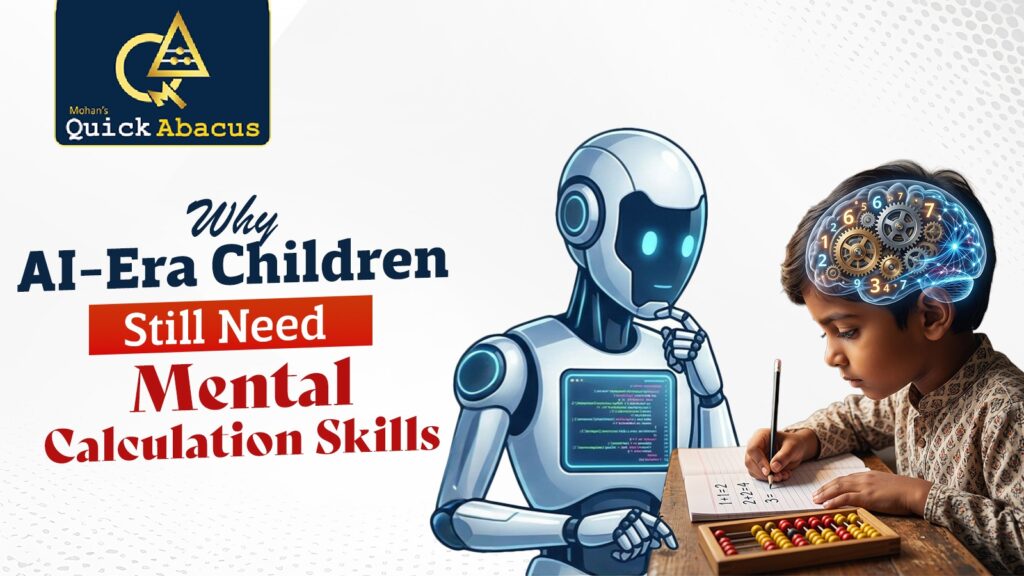
Artificial intelligence can calculate, search, and process information within seconds, but does that mean children no longer need strong mental calculation skills? Quite the opposite. In an AI-driven world, children still need to understand numbers, think logically, make quick decisions, and solve problems independently.
Mental calculation is not simply about getting the right answer without a calculator. It encourages children to develop concentration, number sense, reasoning, memory, and confidence-skills that remain valuable even when technology handles routine calculations.
Why Mental Math Still Matters in the AI Era
Technology can provide answers, but children need the ability to understand whether those answers make sense. Mental calculation encourages them to process information actively instead of depending entirely on digital tools.
Regular practice can help children:
- Strengthen concentration and attention
- Develop better number sense
- Improve logical reasoning
- Build confidence in problem-solving
- Process numerical information more efficiently
These abilities can support learning across mathematics and other academic subjects.
How Abacus and Vedic Maths Training Helps
Abacus and Vedic Maths training introduces children to different approaches to working with numbers. Abacus learning uses visualization and hands-on practice, while Vedic Maths techniques introduce alternative methods for solving calculations efficiently.
Together, these approaches can make mathematical learning more engaging while encouraging children to think rather than simply memorize answers.
Developing Memory Through Calculation
Mental calculation requires children to remember numbers, steps, patterns, and intermediate results. Consistent practice can therefore make activities such as memory improvement classes useful for strengthening attention and recall alongside mathematical learning.
Faster Calculation Is Only One Benefit
Faster calculation skills training can help children become more comfortable with numerical problems, but speed should not be the only goal. Understanding the process is equally important.
A balanced learning program should encourage children to:
- Understand the numerical concept.
- Visualize the problem.
- Select an appropriate calculation method.
- Solve it accurately.
- Check whether the answer is reasonable.
This approach develops both speed and accuracy without making learning feel like a race.
Supporting Overall Brain Development
Mental calculation can be incorporated into brain development programs for children because it encourages active thinking and sustained attention. Similarly, well-designed brain boosting classes for children can combine mathematical exercises with activities that promote memory, reasoning, visualization, and problem-solving.
Preparing Children for a Technology-Driven Future
AI will continue to transform education and everyday life, but fundamental thinking skills will remain essential. Children who can combine technology with independent reasoning are better prepared to question information, make decisions, and solve unfamiliar problems.
The Human Skill AI Cannot Replace
The goal is not to compete with AI in calculation speed. It is to develop children who know how to think, when to use technology, and how to evaluate the information technology provides.
Give your child a stronger foundation for the AI era with engaging mental calculation, abacus, and Vedic Maths learning programs.
Technology can provide the answer, but strong thinking helps a child understand it