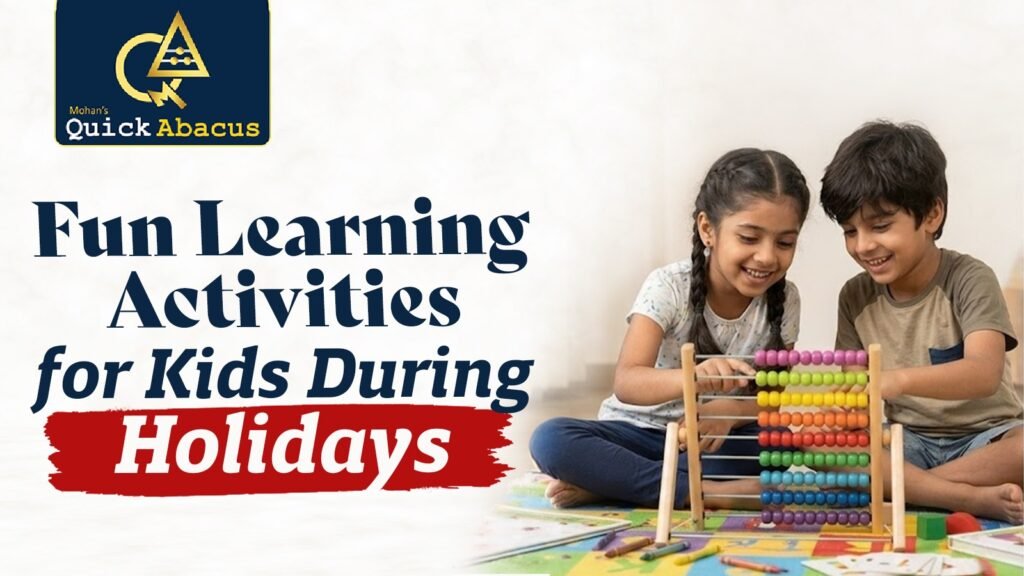
Holidays give children the perfect opportunity to learn beyond textbooks and classrooms. Simple games and creative activities can make learning exciting, practical, and enjoyable. From number games to puzzles and memory challenges, every activity can support useful skills. With creative activities and playful practice, children can continue learning while enjoying their holiday time.
Turn Holiday Time into a Learning Adventure
Long holidays often mean more free time for children, but that does not mean learning has to stop. Parents can introduce short, enjoyable activities that encourage children to think, explore, calculate, and solve problems. Abacus and Vedic Maths training can also introduce children to numbers through interactive methods, making mathematical practice feel less like a traditional lesson and more like a game.
1. Make Numbers a Part of Everyday Games
Children naturally enjoy challenges when they feel like games rather than lessons. Parents can create simple number-based activities at home, such as asking children to calculate shopping totals, identify patterns, compare quantities, or solve quick number puzzles. An experienced abacus trainer can also introduce age-appropriate techniques that help children develop confidence while working with numbers.
2. Try Memory and Observation Challenges
Memory-based games are a simple way to keep children thinking and focused during the holidays. Place a few objects on a table, allow your child to observe them for a minute, and then cover them before asking the child to recall what they saw. Such activities encourage concentration, observation, and recall while providing fun and engaging learning for kids without making them feel pressured.
3. Explore Puzzles and Brain Teasers
Logic puzzles, Sudoku for children, pattern games, riddles, and simple mathematical challenges can turn a quiet afternoon into an exciting thinking session. Instead of immediately providing the answer, encourage children to explain how they reached their solution. These proven math learning techniques can help children develop logical thinking and approach problems with greater curiosity.
4. Add Movement to Learning
Learning does not always have to happen while sitting at a desk. Parents can combine physical activity with simple mathematical tasks. For example, children can count jumps, calculate scores during outdoor games, create number-based treasure hunts, or estimate distances. Combining movement and mental challenges can make brain development training for kids more enjoyable and active.
Easy Holiday Activities to Try
Parents can mix up the activities each day to keep children curious and excited to learn:
- Create a homemade number bingo game.
- Ask children to build patterns using blocks or household objects.
- Play quick addition and subtraction challenges.
- Organize a family puzzle-solving competition.
- Use coins to teach basic counting and calculations.
- Create a treasure hunt using mathematical clues.
- Encourage children to maintain a simple holiday activity scorecard.
5. Encourage Faster Mental Calculations
Short calculation games can become an enjoyable part of a child’s holiday routine. Start with simple additions, subtractions, multiplication, or division questions and gradually increase the difficulty according to the child’s comfort level. Mental math classes for faster calculation can further introduce structured approaches that help children improve calculation speed while strengthening their confidence with numbers.
How Quick Abacus Makes Holiday Learning More Meaningful?
Quick Abacus helps transform holiday practice into an engaging learning experience by introducing children to structured mathematical activities in an enjoyable way. Through age-appropriate exercises and guided practice, children can work on calculation, concentration, memory, and number confidence without making learning feel overwhelming. For parents looking for abacus classes for school children, holiday periods can be an ideal time to introduce consistent practice and develop productive learning habits before school resumes.
Make Learning a Holiday Habit
The goal of holiday learning is not to overload children with additional study. Instead, parents can dedicate just a few minutes each day to meaningful activities. Keeping sessions short, celebrating effort, allowing children to choose activities, and mixing educational games with outdoor play can make the experience positive. When children associate learning with discovery and enjoyment, they are more likely to participate willingly.
Conclusion
School holidays can also be a wonderful time for children to explore, practise, and discover new skills. They can give children the freedom to discover new skills, practise useful concepts, and develop curiosity through enjoyable activities. Whether it is a number game, puzzle, memory challenge, or guided learning session, small activities can create valuable learning moments. With consistency and encouragement, parents can make holiday learning both productive and fun.
Explore Quick Abacus today and make every holiday learning moment count.
“When learning feels like play, every new skill becomes an exciting discovery.”