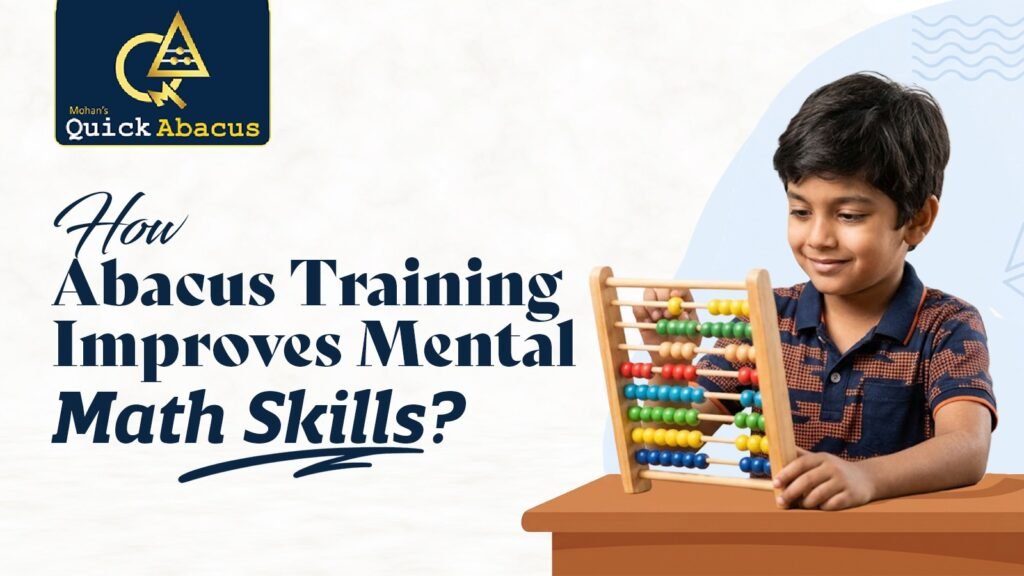
Mental math is an important skill that helps children handle numbers quickly and confidently. Abacus learning introduces children to numbers through visualisation, practice, and structured calculation. Regular practice can strengthen concentration, memory, calculation speed, and numerical confidence. With the right guidance, children can gradually develop faster and more accurate mental calculation skills.
What Is Abacus-Based Mental Math Learning?
Abacus learning uses a physical or imagined counting tool to help children understand numbers and calculations. Instead of depending only on written methods, children learn to visualise quantities and perform calculations mentally. Abacus and Vedic Maths training can give children a structured way to practise mathematical concepts while gradually becoming more comfortable with numbers.
How Does Abacus Training Build Mental Math Skills?
The real value of abacus training goes beyond learning to calculate on a physical device. As children practise different calculations, they gradually begin to picture the abacus mentally. This mental practice helps children solve calculations in their minds while gradually improving their speed, accuracy, and confidence with numbers.
1. Strengthens Number Visualisation
Children learn to associate numbers with specific positions and quantities on the abacus. With consistent practice, they can recreate these positions in their imagination and use the mental image while calculating. Guidance from an experienced abacus trainer can help children develop this visualisation step by step without rushing the learning process.
2. Improves Concentration and Focus
Mental calculations require children to pay attention to numbers, remember intermediate results, and follow calculation sequences. Regular practice encourages them to stay focused on a task for longer periods. When learning is presented through fun and engaging learning for kids, children can practise these skills without feeling that every activity is another conventional classroom exercise.
3. Develops Calculation Accuracy
Speed is useful, but accurate calculation is equally important. Abacus exercises encourage children to follow systematic steps, helping them reduce careless mistakes as they become more familiar with numbers. Repeated practice based on proven math learning techniques can gradually make calculations feel more natural and manageable.
Key Mental Math Benefits of Abacus Practice
With regular and age-appropriate practice, children can work towards developing several useful skills:
Skill | How Abacus Practice Helps |
Calculation speed | Encourages quicker processing of numerical operations |
Concentration | Requires attention throughout each calculation |
Memory | Helps children retain numbers and calculation sequences |
Visualisation | Builds the ability to picture numerical values mentally |
Accuracy | Encourages systematic calculation habits |
Confidence | Gives children regular opportunities to practise and improve |
4. Supports Memory and Cognitive Development
Mental calculation requires children to hold numbers and steps in their minds while solving problems. This repeated mental activity can encourage children to use memory and concentration together. Such structured practice can form part of brain development training for kids, particularly when exercises are adjusted to match a child’s age and current ability.
5. Helps Children Calculate Faster
As children become comfortable with basic operations, they can gradually work with larger numbers and more challenging calculations. Instead of relying entirely on counting or written steps, they learn to process numerical information more efficiently. Structured mental math classes for faster calculation can provide regular opportunities for children to build this ability through guided exercises and progressive practice.
How Quick Abacus Helps Improve Mental Math Skills?
Quick Abacus focuses on making mathematical learning structured, interactive, and approachable for children. Through guided activities, regular practice, and progressive exercises, children can work on calculation, concentration, visualisation, and number confidence. For parents seeking abacus classes for school children, Quick Abacus provides an opportunity to introduce mental math practice in a way that complements regular school learning and encourages children to become more comfortable with numbers.
Why Consistent Practice Matters?
Abacus skills develop through regular practice rather than overnight. Short and consistent sessions can be more effective for children than lengthy and tiring study periods. Parents can encourage children by celebrating progress, allowing them to practise at a comfortable pace, and treating mistakes as part of the learning process. Over time, familiar calculation patterns can become easier to recognise and solve.
Conclusion
Abacus training can give children a practical foundation for developing mental math abilities. By combining visualisation, memory, concentration, accuracy, and repeated calculation practice, it can help children become more confident when working with numbers. The goal is not simply to calculate quickly but to develop a stronger and more comfortable relationship with mathematics.
Make mental math practice an enjoyable part of your child’s learning journey with Quick Abacus.
“When children learn to picture numbers, they begin to see mathematics in a whole new way.”