Have you ever wondered how a child progresses from moving beads on an abacus to solving complex calculations entirely in their mind? This transformation is not magic-it is a fascinating learning journey that develops concentration, visualization, memory, and problem-solving abilities. Modern mental math classes are built around this progression, helping children move from physical tools to powerful mental calculation skills.
1. Concrete Tools (The Physical Era)
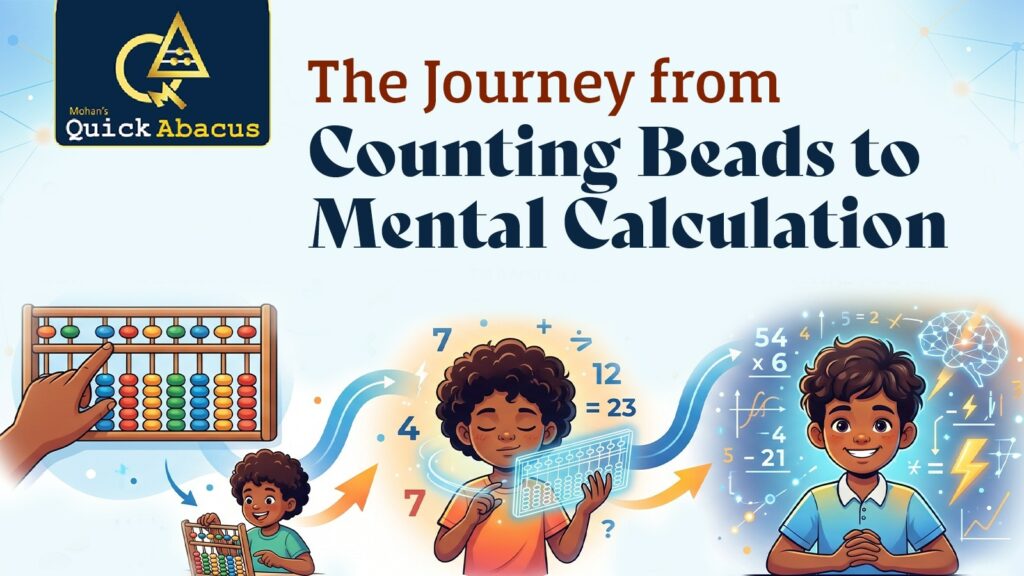
Every learning journey begins with something tangible. For centuries, counting tools such as beads, stones, and the abacus have helped learners understand numbers in a visual and hands-on way.
At this stage, children physically move beads to perform calculations. This tactile experience helps them grasp mathematical concepts more effectively than memorizing numbers alone. Through structured abacus and vedic maths training, children develop a strong numerical foundation while building confidence in handling calculations.
Benefits of the Physical Era
- Better number recognition
- Improved hand-eye coordination
- Strong understanding of place values
- Increased confidence with basic arithmetic
2. The Abstract Shift (The Paper & Symbol Era)
Once children become comfortable using physical tools, they begin transitioning to numbers, symbols, and written calculations. Instead of relying entirely on beads, they learn to visualize mathematical operations through worksheets and exercises.
This stage introduces children to patterns and fast calculation techniques, helping them understand that mathematics is more than just counting-it is about recognizing relationships between numbers.
3. Internalizing the Tool (The Mental Image Era)
This is where the transformation becomes truly remarkable. Children begin creating a mental image of the abacus and perform calculations without touching physical beads.
Through regular practice in mental math classes for faster calculation, students learn to visualize bead movements in their minds. This process strengthens concentration, memory retention, and visualization skills.
Many parents are amazed when children can solve large calculations mentally within seconds while maintaining high accuracy.
4. Pure Cognitive Synthesis (The Modern Neuro-Plasticity Era)
At the highest stage, children no longer consciously rely on an imagined abacus. Instead, their brains process numbers quickly and efficiently through developed neural pathways.
This modern learning approach takes advantage of neuroplasticity-the brain’s ability to adapt and strengthen through practice. As a result, students develop faster thinking, sharper focus, and greater confidence in academic subjects beyond mathematics.
This is why fun and engaging learning for kids plays such an important role. When learning remains enjoyable, children are more motivated to practice and strengthen these cognitive abilities.
Conclusion
The journey from counting beads to advanced mental calculation demonstrates how children can develop strong mathematical abilities through the right learning approach. By progressing from physical tools to mental visualization, they gain valuable skills such as concentration, memory, speed, and confidence. Quikabacus provides effective abacus and mental math training designed to help children master fast calculations in a fun and engaging way, making it an excellent choice for parents looking to build a strong foundation for their child’s future success.
Help your child progress from counting beads to mastering mental calculations with Quikabacus-where learning becomes faster, smarter, and more enjoyable.
The journey from an abacus to mental calculation is the journey from counting to thinking