
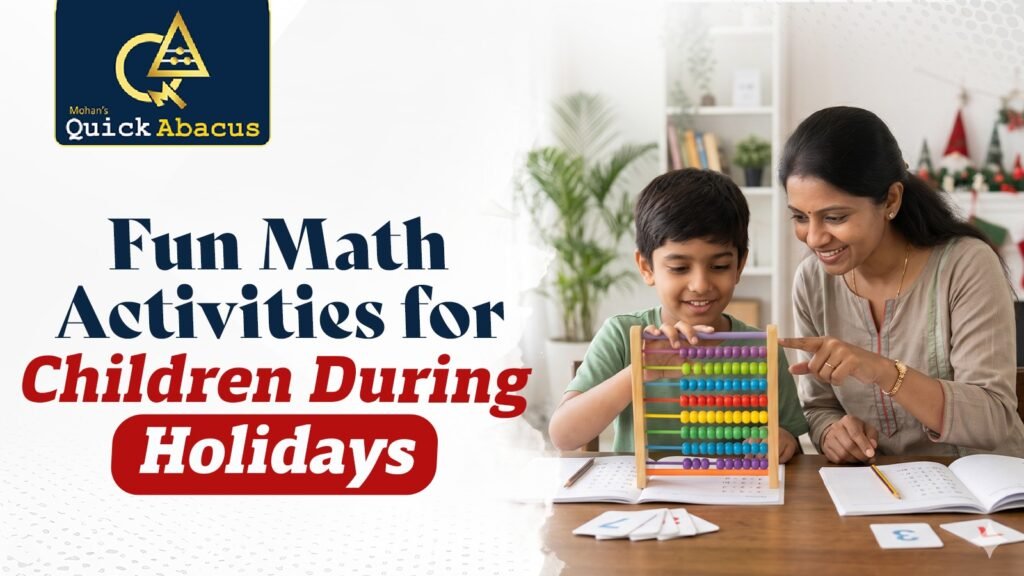
Holidays are an excellent time for children to relax, discover new interests and explore learning outside the classroom. Instead of spending all their free time watching television or playing on mobile phones, children can participate in activities that make learning enjoyable. Mathematics, in particular, can become an interesting subject when introduced through games, puzzles and practical experiences. These activities can also support brain development classes for kids by encouraging logical thinking, concentration and problem solving abilities. Here are some simple ways parents can make mathematics enjoyable during the holidays.
1. Make Learning Enjoyable Through Number Games
Number games help children become familiar with mathematical concepts without making learning feel like a classroom exercise. They encourage children to recognise patterns, think independently and solve simple problems.
Parents can introduce the following activities at home:
- Number Bingo: Prepare number cards and call out simple calculations. Children must identify and mark the correct answers.
- Missing Number Game: Write number sequences with a few numbers missing and ask children to complete them.
- Math Riddles: Give children interesting mathematical clues and encourage them to work out the answers.
- Playing Card Challenges: Use playing cards to practise addition, subtraction and multiplication.
As children become comfortable with these games, parents can introduce slightly more challenging questions and simple fast calculation techniques to improve their speed and accuracy.
2. Discover Mathematics Through Everyday Activities
Daily activities provide several opportunities to introduce children to practical mathematics. When children understand how numbers are used in real situations, learning becomes more meaningful.
While shopping, encourage them to calculate the total price of selected items, compare product costs or work out the change received. During cooking, children can measure ingredients, count quantities and understand basic fractions. Even gardening can become a mathematical activity by measuring plant growth, counting seeds or arranging pots in different patterns.
These small experiences help children apply what they learn in school to everyday situations while developing independent thinking.
3. Introduce Children to Abacus Based Learning
Abacus learning is an interactive way to introduce children to numbers and basic calculations. The use of beads helps them understand numerical values through visual and physical practice. As they progress, children learn different methods of performing calculations.
Enrolling children in abacus classes can provide structured learning with regular guidance and practice. This approach introduces mathematical concepts gradually while encouraging concentration and mental visualisation.
Quick Abacus offers Quick abacus training designed to help children become familiar with abacus techniques through guided learning. Parents should look for teaching methods that suit their child’s age, current abilities and learning pace.
4. Develop Logical Thinking Through Puzzles
Mathematical puzzles are a great way to keep children mentally active during their holidays. Games such as Sudoku, number patterns, shape puzzles and simple brain teasers encourage children to analyse information and find suitable solutions.
Parents can introduce one new puzzle every day and gradually increase its difficulty. Allow children to try different approaches instead of immediately providing the answers.
Regular puzzle solving also complements brain development classes for kids, giving children additional opportunities to practise reasoning, memory and concentration skills in an enjoyable environment.
5. Combine Educational Technology with Learning
Educational websites, interactive quizzes and child friendly learning applications can make mathematics more engaging. Parents can choose age appropriate resources that introduce number recognition, basic arithmetic, shapes and mental maths.
However, digital activities should be balanced with outdoor games, reading and hands on experiences. Parents can also encourage children to explain their answers rather than simply selecting the correct option.
Introducing fast calculation techniques through short online quizzes and offline exercises can make daily mathematical practice more interesting.
6. Build a Simple Holiday Learning Schedule
A regular but flexible learning routine helps children maintain their interest in mathematics without affecting their holiday enjoyment. Parents do not need to organise lengthy study sessions. Even 15 to 20 minutes of meaningful practice can provide opportunities to strengthen existing skills.
Create a weekly plan that includes number games, practical calculations, puzzles and creative learning activities. When considering organised programmes, compare the best abacus classes based on teaching quality, personal attention, practice methods and the child’s learning requirements.
Make Every Holiday a Learning Opportunity
Mathematics can become an enjoyable part of childhood when introduced through creative activities and everyday experiences. Games, puzzles, practical challenges and abacus exercises give children different ways to explore numbers while developing useful thinking skills.
Quick Abacus provides structured learning opportunities for children interested in improving their mathematical abilities. Contact Quick Abacus to explore suitable abacus classes and learning programmes for your child.
Give your child a head start in mathematics with Quick Abacus. Contact us today to get started!
“The best way to learn mathematics is to discover the fun hidden behind every number”.