
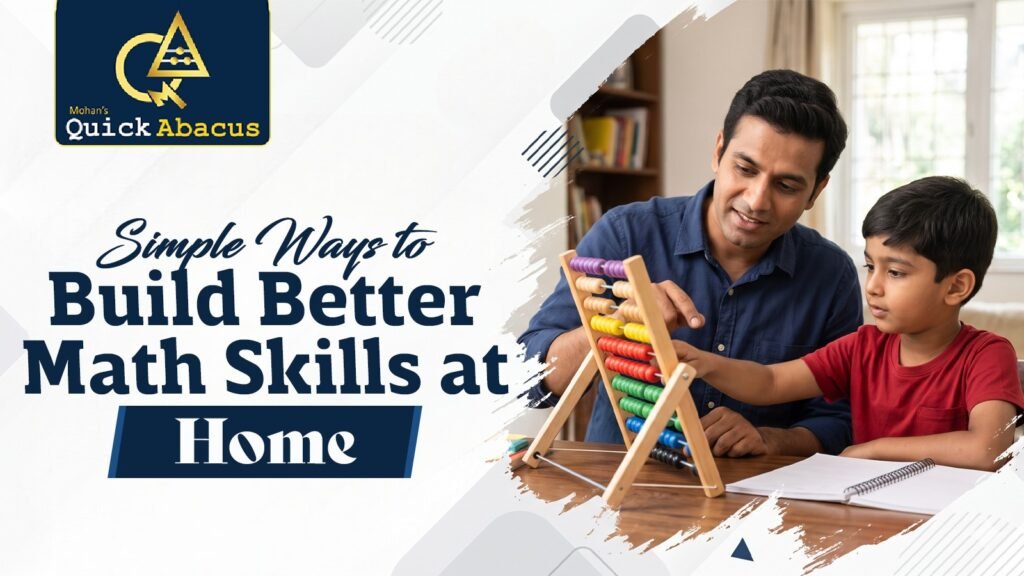
Mathematics is an important part of a child’s education, helping them develop problem-solving abilities, logical thinking and confidence. However, children may sometimes find it difficult to understand calculations or apply mathematical concepts in everyday situations. Parents can make learning easier by introducing simple number activities and practical exercises at home. With regular practice and the right guidance, children can become more comfortable with numbers and enjoy exploring mathematics. Here are some effective ways to strengthen mathematical skills outside the classroom.
1. Make Number Games Part of Everyday Learning
Number games are a simple way to introduce mathematics without making children feel like they are studying. These activities encourage them to recognise patterns, understand number relationships and solve problems independently.
Parents can introduce a few interesting games at home:
- Number Matching: Match numbers with the correct quantities of objects.
- Mental Calculation Challenges: Ask simple addition and subtraction questions during playtime.
- Number Puzzles: Give children missing-number sequences to complete.
- Playing Card Games: Use cards to practise basic arithmetic operations.
Choose games according to the child’s age and understanding. Gradually increasing the difficulty can keep them interested and encourage regular practice.
2. Connect Mathematics with Daily Activities
Children often understand mathematical concepts more easily when they see how numbers are used in real situations. Everyday household activities provide plenty of opportunities for practical learning.
For example, involve children while shopping and ask them to calculate the total cost of selected items. During cooking, encourage them to measure ingredients, count quantities and understand basic fractions. You can also ask them to arrange objects according to size, count household items or identify different shapes.
These small exercises support the learning approach followed in kids brain development classes, where children get opportunities to practise observation, reasoning and problem-solving through engaging activities.
3. Introduce Abacus Learning for Better Calculation Skills
An abacus is a useful educational tool that helps children understand numerical values through visual and hands-on practice. Moving beads to represent numbers makes basic calculations easier to explore and understand.
With regular exercises, children gradually become familiar with addition, subtraction and other mathematical operations. They can also progress towards visualising the abacus and practising calculations mentally.
Parents looking for structured abacus classes should consider factors such as teaching methods, individual attention, regular practice and learning levels. A suitable programme can help children build a strong foundation in mathematics while keeping the learning process interactive.
4. Encourage Mental Calculation Through Practice
Mental calculation helps children solve mathematical problems without depending entirely on written methods or calculators. Parents can begin with simple questions involving addition, subtraction, multiplication and division.
Introduce short calculation challenges during free time and encourage children to explain how they arrived at their answers. This helps them understand the process rather than simply memorising results.
Enrolling in mental math classes can provide additional guidance through structured exercises and progressive learning activities. Consistent practice can gradually improve children’s familiarity with numbers, calculation accuracy and confidence.
5. Explore Different Methods of Learning Mathematics
Every child has a different way of understanding mathematical concepts. Some children learn better through visual examples, while others prefer practical activities or step-by-step explanations.
Introducing different calculation methods can make learning more interesting. For instance, Vedic maths classes introduce alternative techniques and shortcuts for solving arithmetic problems. These methods can encourage children to explore different approaches instead of following only one calculation method.
Parents can combine these exercises with number puzzles, mathematical quizzes and simple home challenges to create a varied learning experience.
6. Create a Simple Daily Math Routine
Regular practice is important for developing stronger mathematical abilities. However, children do not need lengthy study sessions to become familiar with numbers. Short and enjoyable activities can make a difference when practised consistently.
Parents can create a simple weekly schedule that includes:
- Number games and calculation challenges.
- Abacus exercises and visual learning.
- Everyday mathematical activities.
- Puzzles that encourage logical thinking.
Along with activities at home, suitable kids brain development classes can provide structured opportunities to practise concentration, memory and reasoning skills. The activities should match the child’s age, interests and learning pace.
Making Mathematics a Part of Everyday Life
Building better math skills does not always require textbooks or lengthy exercises. Simple games, household activities, calculation challenges and guided learning can help children develop a better understanding of numbers.
Parents can also explore Vedic maths classes to introduce different calculation techniques and make mathematical practice more engaging. Quick Abacus offers structured learning opportunities for children who want to strengthen their numerical abilities through guided practice.
Help your child develop stronger math skills with engaging learning programmes at Quick Abacus. Contact us today!
“Every small step in learning numbers builds the confidence to solve bigger challenges”.