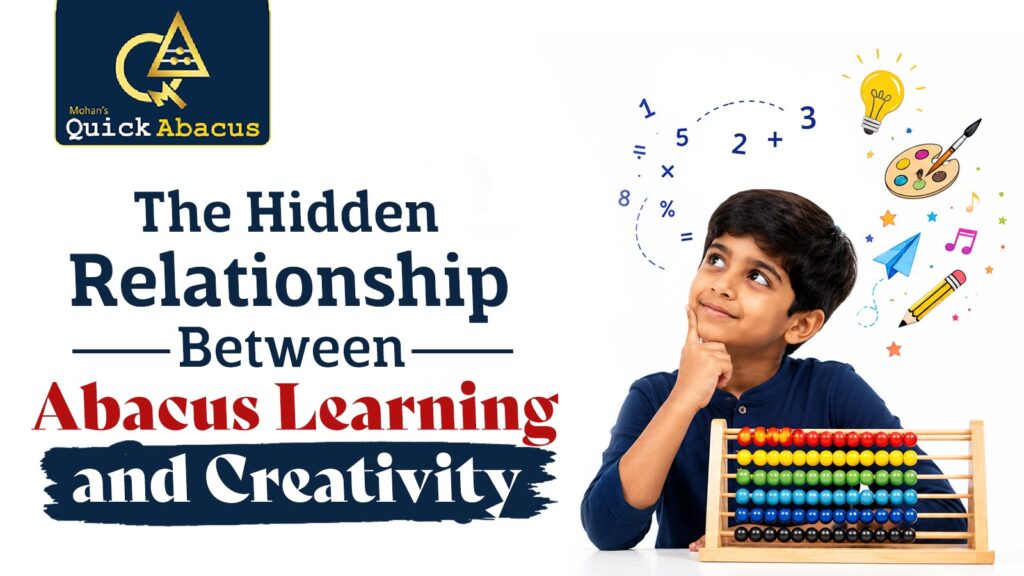
Creativity is often associated with drawing, storytelling, music, or imaginative play. But creativity also develops through the way children observe, connect, and solve problems. Surprisingly, mathematical learning can contribute to these abilities too. Abacus learning offers children an interactive way to work with numbers while encouraging visualization, flexible thinking, and mental exploration.
The connection between an abacus and creativity may not be immediately obvious, but the process of turning physical calculations into mental images can encourage children to approach problems from different perspectives.
From Moving Beads to Visual Thinking
When children work with an abacus, they do more than count beads. They gradually learn to visualize their positions, quantities, and movements in their minds. This shift from physical interaction to mental imagery encourages children to form and manipulate pictures internally.
Visualization is an important part of creative thinking because it allows children to imagine possibilities before acting on them.
How Abacus Learning Encourages Creativity
1. Encourages Flexible Problem-Solving
A calculation can often be approached in more than one way. Abacus practice encourages children to recognize number relationships and explore efficient approaches instead of relying only on memorized steps.
2. Strengthens Memory and Visualization
Regular abacus practice can support activities designed to improve memory in kids. Remembering bead positions, numbers, and calculation patterns requires active recall and visualization.
3. Develops Focused Thinking
Children need sustained attention when performing calculations mentally. This makes structured learning particularly useful for parents looking for ways to increase concentration for children.
Beyond Calculation: Building Mental Agility
The benefits of abacus learning extend beyond arithmetic. In well-designed mental math classes, children are encouraged to visualize numbers, identify patterns, and solve problems efficiently. These habits can support a more flexible approach to challenges in everyday learning.
Parents searching for the best abacus classes should therefore look beyond speed-based training. A quality program should encourage understanding, visualization, confidence, and independent thinking.
A Creative Approach to Mathematical Learning
Creativity grows when children are given opportunities to think, experiment, and discover. Abacus learning introduces these elements into mathematics by transforming numbers into visual and interactive experiences.
Help your child discover the creative side of mathematics through engaging abacus and mental math learning.
When children learn to visualize numbers, they begin discovering new ways to imagine possibilities