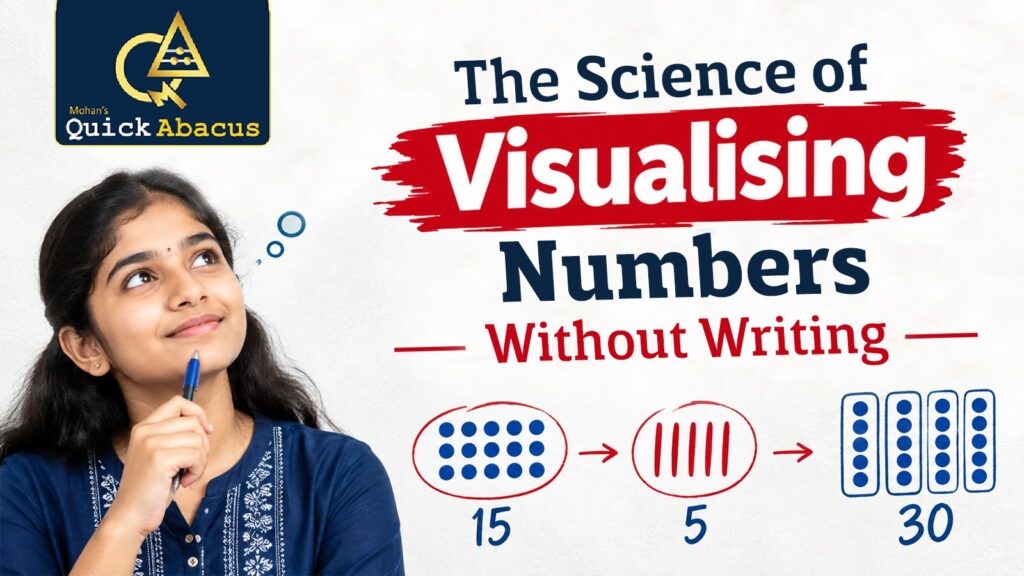
Visualising numbers helps children calculate without depending on paper or a calculator. Abacus learning trains the mind to imagine numbers as positions, movements and patterns. With regular practice, children can gradually perform calculations mentally with greater confidence. This skill combines concentration, memory and speed to make mathematics easier and more enjoyable.
How Children Learn to See Numbers Mentally?
An abacus gives children a visual way to understand numbers before they begin calculating them mentally. During practice, they learn to imagine bead movements even when the physical abacus is no longer in front of them. This approach is an important part of abacus and Vedic maths training, where children develop calculation skills through structured practice.
Building Mental Calculation Skills
Mental calculation is not simply about memorising answers. Children learn to process numbers, recognise patterns and perform operations in their minds. With guidance from an experienced abacus trainer Bangalore, students can gradually move from physical calculations to visual calculations at their own pace.
Making Mathematics More Enjoyable
Learning becomes more effective when children actively participate instead of simply memorising formulas. Games, timed activities and interactive exercises can make mathematics feel less like a classroom task. This creates fun and engaging learning for kids while encouraging them to practise regularly.
Why Visualisation Matters?
When children repeatedly imagine numbers and operations, they exercise several cognitive skills at the same time. They learn to hold information in their minds, focus on a calculation and recall number patterns. These are some of the benefits associated with proven math learning techniques that focus on active mental practice.
Skills Developed Through Regular Practice
- Faster number recognition
- Better concentration
- Stronger memory
- Improved calculation speed
- Greater confidence with numbers
From Abacus Practice to Faster Mental Maths
As children become comfortable visualising the abacus, they can begin performing calculations without physically moving the beads. Regular mental math classes for faster calculation can help them develop accuracy and speed while making mental arithmetic a more natural part of everyday learning.
Supporting Overall Cognitive Development
Visual calculation also encourages children to manage information mentally while staying focused on a task. When combined with consistent practice and age-appropriate activities, it can become part of broader brain development training for kids, supporting useful learning habits beyond mathematics.
How Quick Abacus Helps Children Visualise Numbers?
- Starts with hands-on learning: Children first learn numbers using the physical abacus before moving towards mental calculation.
- Builds mental visualisation: With regular practice, children learn to imagine the abacus beads in their minds and perform calculations without writing.
- Develops calculation speed: Quick Abacus gradually introduces activities that help children become faster and more confident with numbers.
- Encourages concentration: Visualising numbers requires children to focus on the calculation, which can strengthen their attention and mental processing.
- Uses structured learning: Quick Abacus follows age-appropriate and progressive learning activities so children can develop their skills step by step.
- Makes mathematics enjoyable: Interactive exercises and engaging activities can make regular calculation practice more interesting for children.
- Builds confidence: As children become comfortable solving calculations mentally, they can approach mathematics with greater confidence.
Building a Strong Foundation Early
Introducing these skills during school years can help children become more comfortable with numbers and mathematical thinking. Structured abacus classes can provide a progressive learning environment where students practise visualisation, calculation and concentration step by step.
Conclusion
With regular practice, abacus classes can help students develop stronger number sense, mental calculation skills and confidence in mathematics. Visualising numbers teaches children to approach calculations with greater focus and clarity, making maths a skill they can understand, practise and enjoy.
Help your child build faster thinking and stronger number skills with Quick Abacus today.
“When children learn to see numbers in their minds, mathematics becomes something they can understand, not just something they have to solve.”