Children’s Day is a special occasion that celebrates childhood, curiosity and the joy of learning. It reminds us that every child deserves opportunities to explore their interests, discover new talents and develop useful skills. Children learn in many ways, especially when they get opportunities to explore new ideas, participate in activities and discover things through real life experiences. When children learn through games, creative activities and practical experiences, they become more interested in discovering new things. This Children’s Day, let’s explore some enjoyable ways to make education more engaging and meaningful for young learners.
1. Turn Learning into an Interactive Experience
Children enjoy learning when they can actively participate instead of simply listening or memorising information. Interactive activities allow them to explore concepts at their own pace while developing curiosity and confidence.
Parents and teachers can introduce activities such as word games, quizzes, storytelling sessions, simple science experiments and number challenges. These activities encourage children to ask questions, share ideas and understand new concepts through experience.
For example, a simple mathematics quiz can turn number practice into an exciting challenge. Similarly, storytelling activities can improve vocabulary, imagination and communication skills.
2. Encourage Mathematical Thinking Through Fun Activities
Mathematics becomes easier to understand when children learn through practical examples. Rather than focusing only on calculations in textbooks, parents can introduce numbers through everyday activities.
Simple activities such as counting objects, identifying patterns, solving puzzles and playing number games can help children develop logical thinking.
For children who enjoy exploring numbers, Vedic maths classes can introduce interesting calculation methods and mathematical shortcuts. These learning techniques can make arithmetic practice more engaging while encouraging children to approach problems in different ways.
3. Introduce Abacus Learning for Better Number Understanding
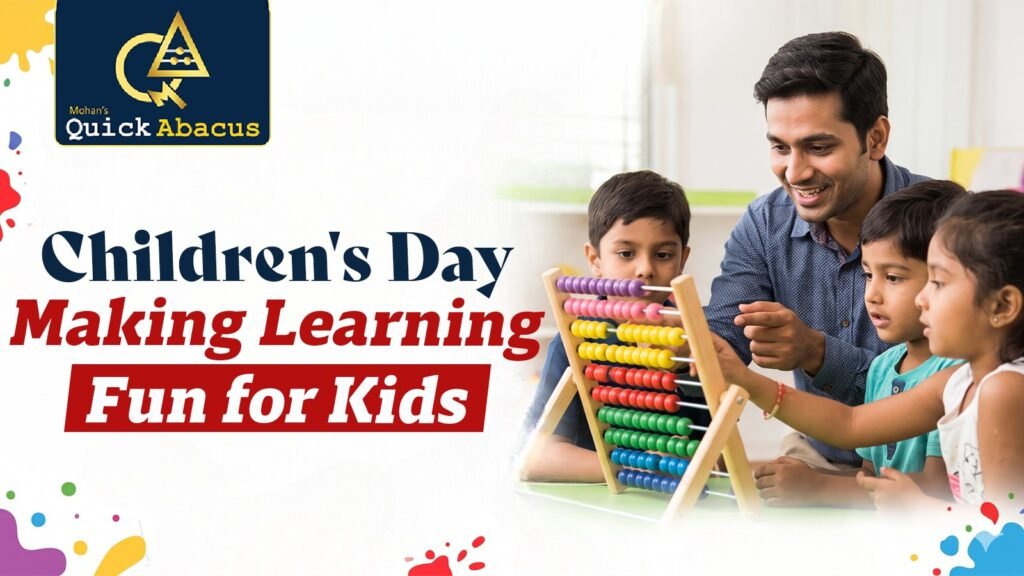
An abacus is a useful educational tool that introduces children to numbers through visual and hands on activities. By moving beads to represent different numerical values, children can understand calculations in an interactive manner.
With regular guidance, abacus practice can encourage concentration, visualisation and calculation skills. Parents exploring best abacus classes should consider teaching quality, individual attention, structured learning methods and opportunities for regular practice.
At Quick Abacus, Quick abacus training introduces children to abacus based learning through guided activities and progressive practice. It provides an opportunity for children to explore mathematics beyond traditional classroom exercises.
4. Make Brain Games Part of Everyday Learning
Brain games are an enjoyable way to encourage children to think, observe and find solutions. They also provide a refreshing break from conventional study routines.
Some interesting activities include:
- Sudoku: Introduces number placement and logical reasoning.
- Memory Games: Encourage children to remember objects, pictures or sequences.
- Shape Recognition: Helps children identify patterns and understand basic geometry.
- Puzzle Challenges: Encourage creative thinking and problem solving.
Parents can introduce different games throughout the week to keep children interested. Simple challenges can gradually become more complex as children develop their problem solving abilities.
5. Build Confidence Through Mental Mathematics
Mental calculation activities encourage children to solve number problems without depending entirely on calculators or written methods. Starting with small additions, subtractions and multiplication questions can make practice enjoyable.
Enrolling in mental math classes can provide structured opportunities to practise calculations, improve number familiarity and develop problem solving approaches. Children can also participate in friendly calculation challenges at home.
Along with regular practice, introducing simple mathematical techniques through Vedic maths classes can help children discover different ways to approach arithmetic problems.
6. Create a Positive Learning Environment
Children learn better when they feel comfortable asking questions and making mistakes. Parents should appreciate their efforts, encourage curiosity and avoid putting unnecessary pressure on them to achieve immediate results.
A balanced routine that includes reading, outdoor activities, creative hobbies and mathematics practice can support their overall development.
Parents can also explore mental math classes and structured learning programmes based on their child’s interests and abilities. Choosing suitable activities makes it easier for children to enjoy learning consistently.
Celebrate Childhood Through Meaningful Learning
Children’s Day is an opportunity to remind children that education can be exciting, creative and full of discovery. Through games, puzzles, mathematical activities and interactive learning, parents and teachers can make every learning experience more enjoyable.
Quick Abacus encourages children to explore mathematics through engaging activities and Quick abacus training. Contact Quick Abacus to discover suitable learning programmes for your child.
Make learning mathematics fun and engaging for your child with Quick Abacus. Get in touch with us today!
“A child’s curiosity is the beginning of every great discovery”.