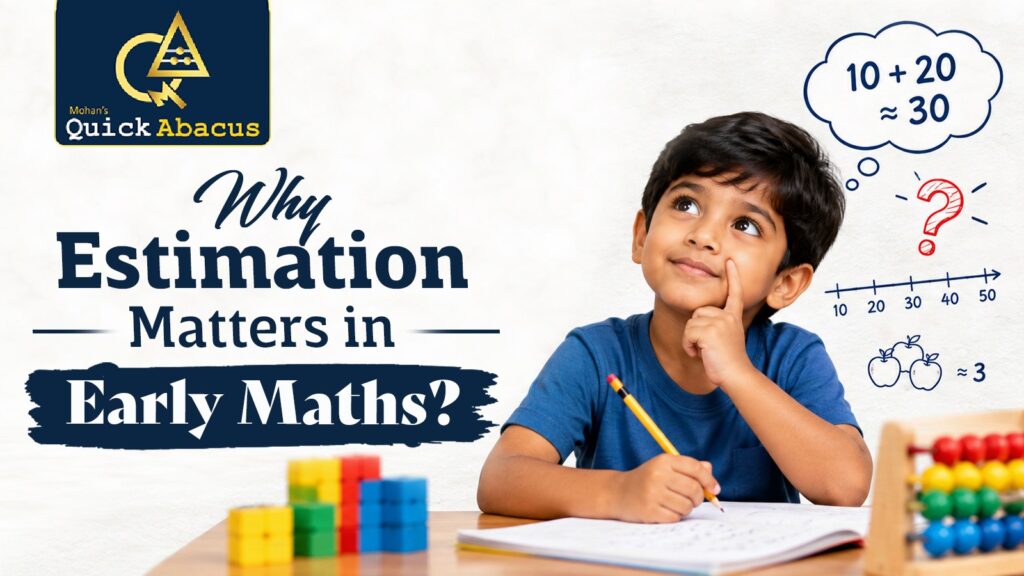
Estimation helps children understand numbers without needing to find the exact answer every time. It teaches them to make sensible guesses using number relationships and everyday logic. Early estimation skills can improve confidence when children face unfamiliar mathematical problems. With regular practice, children can learn to judge whether an answer is reasonable before calculating it exactly.
What Is Estimation in Maths?
Estimation means finding a close and sensible answer instead of calculating an exact result. For example, children can learn to identify nearby numbers and use them to make quick and sensible calculations. Abacus and vedic maths training can introduce children to number relationships while helping them become more comfortable with mental calculations.
Why Should Children Learn Estimation Early?
Estimation encourages children to think before they calculate. Instead of immediately reaching for a written method, they begin asking whether an answer seems too high, too low or approximately correct. With support from an experienced abacus trainer, children can practise this thinking through simple and age-appropriate activities.
Estimation Makes Maths More Practical
Children use estimation in many everyday situations, such as judging how much time is left, comparing quantities or deciding whether they have enough money for something. When learning includes games and real-life examples, fun and engaging learning for kids can make these concepts easier to understand and remember.
Skills Children Develop Through Estimation
Regular estimation activities can encourage children to develop:
- Number sense
- Logical thinking
- Quick decision making
- Mental calculation
- Confidence with numbers
- Better understanding of quantities
These abilities can become stronger when children follow proven math learning techniques that encourage them to think about numbers rather than simply memorise calculation steps.
How Quick Abacus Helps With Estimation?
Quick Abacus supports children in developing estimation skills through practical number activities and regular mental practice. Through structured abacus activities, children learn to recognise quantities, compare numbers and mentally process calculations. This foundation can help them make quicker and more sensible estimates before moving toward exact answers.
From Estimation to Faster Calculation
Estimation can also prepare children for quicker mental arithmetic because they learn to recognise numbers and patterns more naturally. Regular mental math classes for faster calculation can further strengthen this ability through repeated practice and progressively challenging exercises.
Conclusion
Estimation gives children an important mathematical habit: think first, calculate next. Abacus classes for school children can help build this habit through structured practice, visual learning and mental number activities, giving children a stronger foundation for confident mathematical thinking.
Explore Quick Abacus and take the first step towards making everyday maths more confident and enjoyable.
“Good estimation helps children understand numbers before working out the exact answer”.