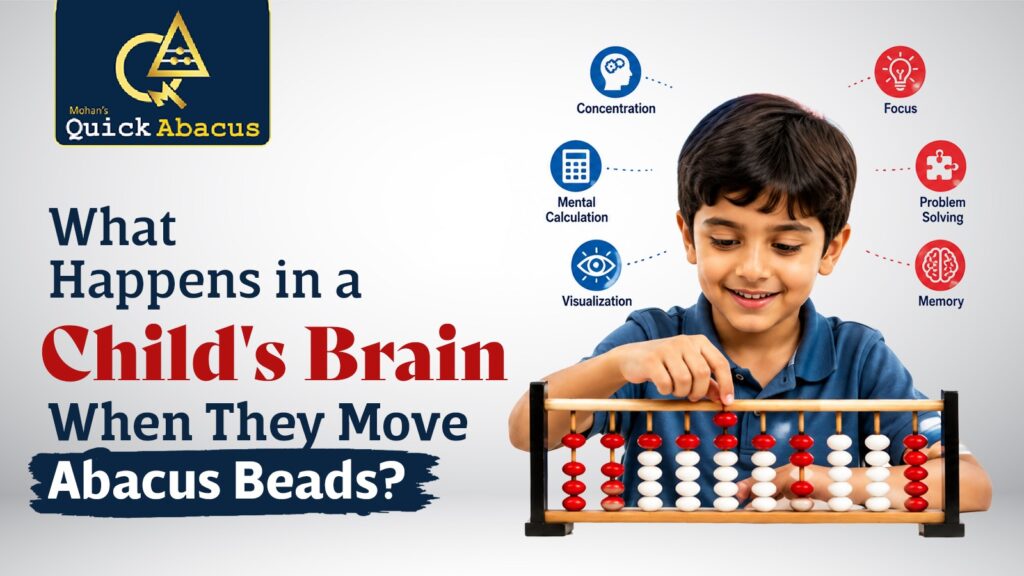
A child moving colourful abacus beads may appear to be performing a simple counting exercise, but behind those small movements, the brain is actively processing numbers, patterns, visual information, and hand movements. Abacus learning combines physical interaction with mental calculation, creating an engaging learning experience that goes beyond memorising numbers.
This is one reason why best abacus classes focus not only on calculation speed but also on building concentration, visualization, memory, and logical thinking from an early age.
How Moving Beads Engages the Brain
When children move abacus beads, they receive visual and tactile information simultaneously. They see the beads, feel their movement, and associate each position with a numerical value. This combination encourages the brain to connect physical actions with abstract mathematical concepts.
From Physical Beads to Mental Images
With regular practice, children gradually begin imagining the abacus in their minds instead of physically moving the beads. This mental visualization allows them to perform calculations internally.
The process can strengthen skills such as:
- Visual memory
- Concentration and attention
- Number recognition
- Mental visualization
- Logical reasoning
- Processing speed
Building Mental Math Skills
As children progress, they learn to calculate without depending entirely on paper, fingers, or physical objects. This development makes mental math classes particularly valuable for children who enjoy learning through visual and interactive methods.
The ability to visualize numbers and manipulate them mentally can also make mathematical problem-solving feel more intuitive and engaging.
Abacus and Broader Mathematical Learning
Abacus learning can complement other approaches such as vedic maths classes, where students explore alternative calculation techniques and number relationships. While the methods differ, both approaches encourage children to become more comfortable with numbers and mathematical thinking.
Supporting Cognitive Development
Abacus activities can also form part of cognitive development classes, where children are encouraged to strengthen attention, memory, reasoning, and problem-solving abilities through structured activities.
The key is consistent, age-appropriate practice rather than simply focusing on speed. When children enjoy the learning process, they are more likely to remain engaged and develop confidence in mathematics.
The Learning Journey Beyond the Beads
Moving abacus beads is only the beginning of a child’s mathematical learning journey. With consistent practice, children can gradually develop the ability to visualize numbers, concentrate for longer periods, and approach calculations with greater confidence. The combination of hands-on learning and mental visualization makes abacus training an engaging way to introduce children to mathematical thinking.
For parents looking for best abacus classes, a well-structured program that focuses on understanding, visualization, and practical learning can help children build strong mathematical and cognitive foundations.
Give your child a smarter way to explore numbers – discover engaging abacus, mental math, and cognitive learning programs today.
When little hands move the beads, young minds begin building the power to think beyond numbers