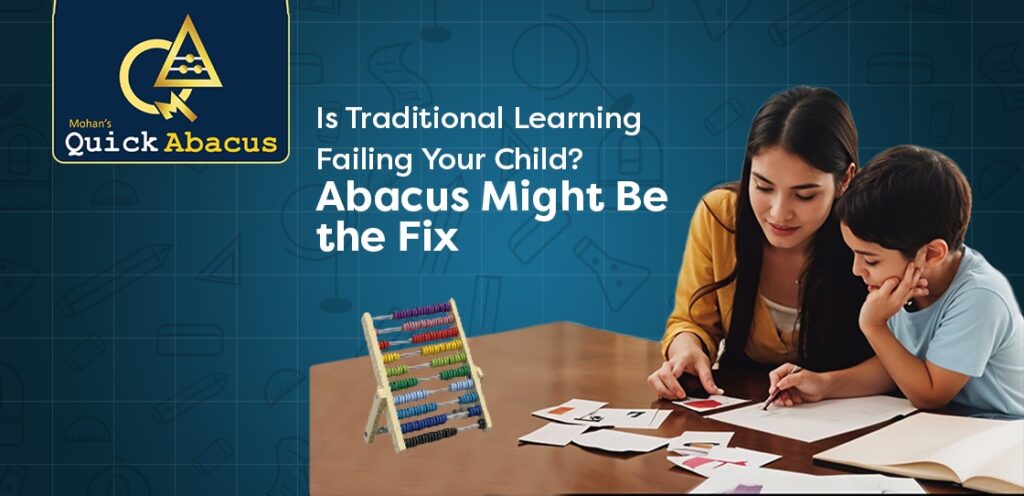
Are you noticing that your child struggles to engage with the usual lecture, textbook combo? You’re not alone. Many kids today don’t thrive under traditional teaching methods, which often rely heavily on repetition and passive learning. While this approach works for some, it can leave many young learners feeling unmotivated, invisible, and overwhelmed.
This is where abacus learning steps in as an effective, brain-based alternative a method that redefines what it means to learn math and think critically.
🧩 Why Traditional Methods Often Miss the Mark
Conventional education usually emphasizes:
🧠 Memorizing facts and formulas
💭 Listening to the teacher read aloud
✍️ Completing worksheets in silence
For students who are visual, kinesthetic, or hands-on learners, such methods can feel boring, isolating, or even confusing. These children often fall behind in math and other subjects—not for lack of intelligence, but because they learn differently.
➡️ Discover a transformative style: Hands‑On, Minds‑On: The Learning Style That Works Best for Kids Today
🎯 What Makes Abacus a Brain-Based Success
More than a counting aid, the abacus is a brain-training system that strengthens children’s cognitive capacities by engaging multiple neural pathways. Here’s why it works so well:
- Multisensory Learning
Kids see, touch, and move while they learn, reinforcing memory and neural connectivity.
- Visual Abacus Technique
With regular abacus training, children start picturing the tool in their heads and solving equations entirely through mental abacus, a skill that enables rapid and precise calculation—no physical beads needed
- Bi-Hemispheric Activation
It engages both the analytical left hemisphere and the creative right hemisphere, helping children think laterally and logically .
- Rapid Neuroplasticity
Studies link abacus training with improved working memory and stronger synaptic connections.
📈 Transformative Benefits Kids Experience
Through consistent abacus use, Quick Abacus students gain:
⚡️ Speed and accuracy in mental calculations (ideal for tests and real-life math)
🧠Research shows that regular abacus practice enhances children’s short-term memory, visual recognition, and ability to manipulate spatial information mentally.
🧩 Better problem-solving as they learn to break down complex problems logically
✨ Children build self-assurance and overcome math fear through consistent achievements and skill mastery.
🎯 Improved focus and concentration—skills that benefit every subject, not just math.
➡️ Read more: How Abacus Enhances Memory, Focus, and Cognitive Speed in Kids
👨👩👧👦 The Quick Abacus Advantage
At Quick Abacus, we design programs that:
🌍 Designed for varied learning preferences—whether your child needs visual, hands-on, or sound-based instruction.
🔄 Provide gradual progression—from physical beads to mental visualization
🎯 Are engaging and confidence-building, not stress-inducing
By combining educational neuroscience (e.g. multisensory stimulation, neuroplasticity, visual-spatial training) with proven abacus techniques, our students thrive both academically and mentally.
🎁 See the Difference for Yourself
If your child:
- Struggles to concentrate or loses interest quickly
- Is anxious about math or other subjects
- Prefers hands-on or visual learning styles
Then abacus training could be the key to unlocking their potential.
👉 Schedule a Free Demo Class and watch your child transform from frustrated to focused through brain-powered learning.
✨ Discover more about our success stories and philosophy at www.quickabacus.in