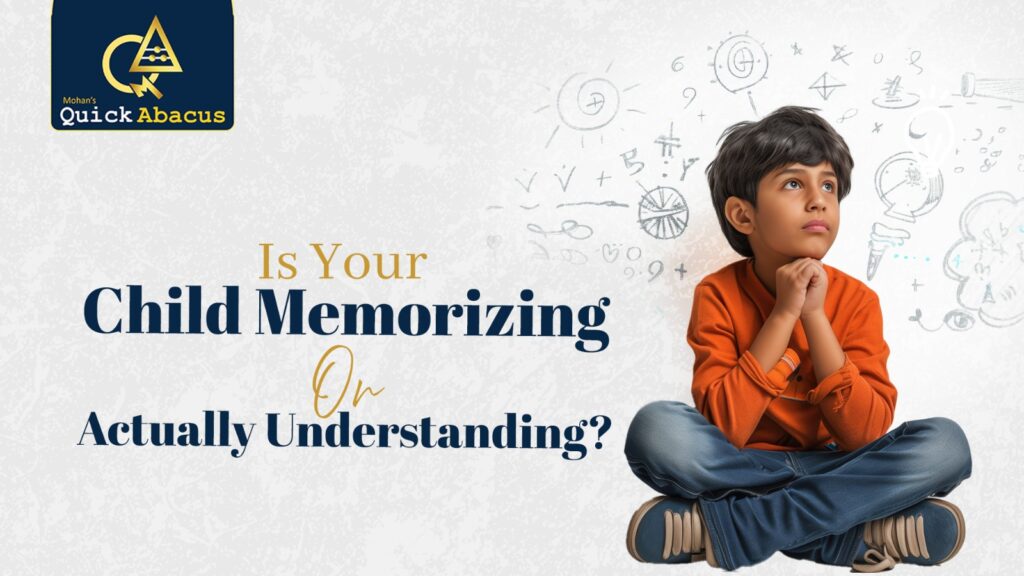
Many parents celebrate when their young children quickly recite multiplication tables or count effortlessly up to one hundred. However, a major difference exists between simple rote memorization and a true, deep comprehension of core mathematical concepts. Memorization offers a temporary fix for passing immediate school tests, whereas genuine understanding builds permanent problem-solving skills. Discovering how your child processes numbers is the vital first step toward unlocking their long-term academic potential.
The Danger of Rote Learning in Early Math
In traditional schooling setups, children often learn to repeat numbers, formulas, and rules by heart without grasping the logic behind them. This mechanical approach frequently fails when students encounter complex word problems that require flexible, analytical thinking. To prevent this learning gap, parents turn to specialized kids brain development classes that prioritize conceptual clarity over quick, repetitive memorization.
When children learn to visualize numbers instead of just memorizing facts, mathematics transforms from a boring, intimidating subject into an exciting puzzle. Specialized mental arithmetic tools bridge this gap by turning abstract math symbols into physical, tactile objects that children can see and touch.
Signs Your Child Understood the Concepts
How can you determine if your child is merely memorizing or genuinely processing the mathematical logic? Look for these distinct learning behaviors during their study hours:
- Concept Application: They can easily apply a math rule learned in one specific problem to an entirely different real-world scenario.
- Explaining the Process: They can clearly explain how they arrived at an answer, demonstrating the step-by-step logic they used.
- Handling Errors: When they make an arithmetic mistake, they can track back through their steps to identify and correct the error independently.
- Visualizing Quantities: They see the number “5” and automatically picture five physical objects, rather than just recognizing a symbol on a page.
Building Deep Math Logic with the Abacus
If you want to move away from traditional memorization, structured abacus classes offer a brilliant solution for young minds. Moving beads on a calculation frame helps children develop an absolute understanding of place value, addition, and subtraction through physical touch. Investing time in abacus training for kids helps build a concrete spatial image of arithmetic operations directly inside their minds. Enrolling your child in the best abacus classes ensures they shift smoothly from mechanical repetition to intuitive, lifetime math mastery.
Conclusion
True mathematical competency goes far beyond memorizing formulas; it requires a deep, fundamental understanding of how numbers interact. By identifying the signs of rote learning early, you can successfully guide your child toward a future of logical thinking and analytical confidence.
Connect with Quick Abacus today to shift your child from rote memorization to true math mastery!
True learning begins when a child understands the ‘why,’ not just remembers the ‘what.