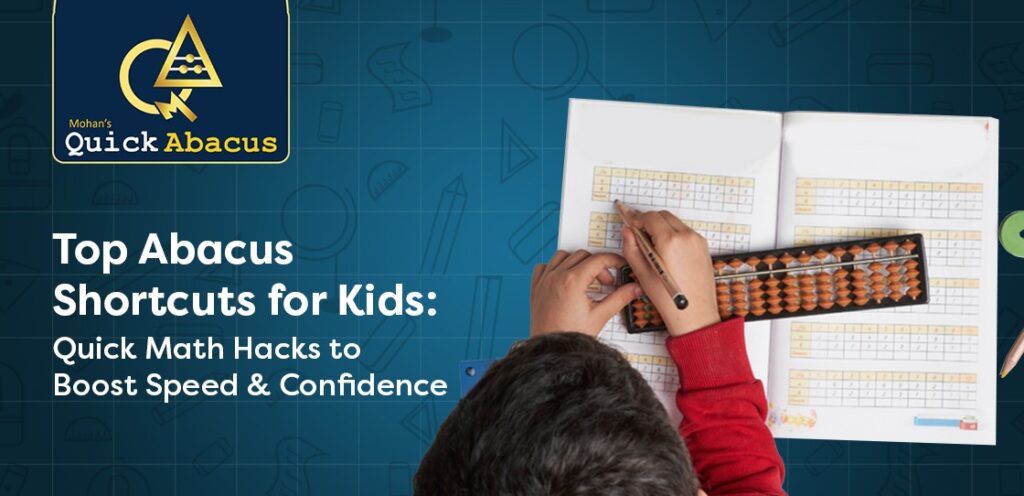
Learning through an abacus isn’t just about counting, it’s about mastering clever shortcuts that sharpen your child’s mental math skills. Whether in the classroom or at home, these abacus tricks make math lightning fast, fun, and exciting! Let’s uncover a collection of clever abacus strategies and fast-thinking tricks crafted just for growing brains.
1. The Complement Trick: Simplify Addition & Subtraction
Instead of adding or subtracting directly, teach your child to use complements—to or from 10.
Addition shortcut: For 8 + 7, think of 8 + 2 = 10, then add the remaining 5 to make 15.
Subtraction shortcut: For 15 – 9, subtract 10 first (getting 5), then add back 1 (resulting in 6).
This technique tones down complexity and is a great way to practice through visualization on the abacus.
2.Finger Abacus: Mental Beading Made Easy
Kids can learn to simulate abacus movements using their fingers, especially helpful for visual or kinesthetic learners. Once a mental image takes hold, solving complex sums mentally becomes a breeze.
3. Left-to-Right Processing: A Smarter Way to Add
Break free from the usual right-to-left routine, start with the largest place values and work left to right to simplify mental math and speed up results.
Example: 34 + 17: Add 30 + 10 = 40, then add 4 + 7 = 11, and combine—giving 51.
This method enhances number sense and streamlines calculations.
4. Mental Abacus Visualization: No Beads, No Problem
With practice, students transition from using a physical abacus to visualizing it mentally, leading to instant and accurate calculations. This skill, known as mental abacus, dramatically improves processing speed and engages both hemispheres of the brain.
5. Break-It-Down Technique: Tackle Big Numbers Easily
Encourage kids to break tough problems into small, human-friendly pieces.
Example: For 47 × 6, they can do 40 × 6 = 240 and add 7 × 6 = 42, arriving at 282 quickly.
This reinforces strong problem-solving habits and supports mental agility.
6. Fun Brain Exercises Every Abacus Learner Should Try
- Here are exciting mini-challenges kids can incorporate into their practice for sharper math thinking:
- Speed Calculation Challenge: Solve as many sums as possible in 60 seconds.
- Visualization Game: Memorize bead placements and replicate accurately.
- Dual-Hand Coordination: Use both hands for different operations simultaneously.
- Reverse Problems: Give the answer and ask kids to reconstruct the question.
Why These Abacus Shortcuts Make a Real Difference
| Advantage | Why It Works |
|---|---|
| Better number sense | Pattern-learning fosters intuitive calculation |
| Enhanced focus & memory | Multisensory involvement strengthens neural connections |
| Mental flexibility | Visualization aids quick problem solving |
| Confidence in learning | Mastery of techniques boosts engagement and academic momentum |
Take It Further with Quick Abacus
At Quick Abacus, we don’t just teach these shortcuts—we integrate them into progressive, fun, and stress-free lessons. Our programs help children master mental abacus, calculation strategies, and problem-solving habits that last a lifetime.
→ Curious how your child can level up their math skills? Check out: Hands-On, Minds-On: The Learning Style That Works Best for Kids Today
Ready to Turn Beads into Brainpower?
Let your child explore the exciting world of abacus shortcuts, where problem-solving becomes a game, and numbers turn into adventures.
👉 Register today and watch them fast-track their math confidence with creativity and fun.